
February is National Children’s Dental Health Month. The National Children’s Dental Health Month is a…
Dental X-Rays: Are They Really Necessary?
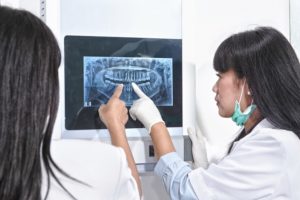
Part of your care at our dental office typically involves capturing routine x-ray images of your teeth and mouth for diagnostic purposes. Dental x-rays are extremely significant in the diagnostic process for your dental care.
Dental x-rays capture an image of the teeth, bones, and soft structure within your mouth. By viewing this image, our dental team can:
- Identify cavities not visible by looking in your mouth (such as between your teeth)
- Show any bone loss that may be occurring under the gum line
- Identify any cysts, growths, or abscesses within your mouth
- Accurately plan treatments for problem areas (such as root canals, large cavities, etc.)
What to Expect
Dental x-rays use a very small amount of radiation to capture their images, but is small enough to merit their use as the benefit is far greater than any potential radiation risk. During the procedure, every precaution is taken. You will be covered with a lead apron to shield your body.
In preparation for the X-Ray, one of our dental technicians will have you bite down on a piece of cardboard or plastic that holds film near the targeted areas or teeth. He/she will then align equipment to capture the image correctly and at the right angle.
Once the film and equipment is in place, our dental technician will step outside or behind a protective shield to take the image.
X-Rays are not painful and only take seconds to capture. Especially with bitewing images, some patients may experience a gag reflex due to the film placement in the mouth. It can be helpful to breathe deeply and focus on something other than the x-ray for these few uncomfortable seconds.
Types of Dental X-Ray Images
There are several types of images that your dentist may capture:
- Bitewing X-Rays: Images of the back teeth (upper and lower) in one single image
- Occlusal X-Rays: Images of the floor or roof of the mouth
- Panoramic X-Rays: A “panoramic” view of the jaw line, teeth, sinuses, and nasal area.
- Periapical X-Rays: Images that show the entire tooth from the bones to the root to the tip.
Typically, bitewing images are taken every 2-3 years (for adults). If patients are at high risk for developing cavities or are under 18, these could be captured as often as every 6 months.
X-Ray images are an important part of dental care and help us diagnose as well as treat many dental issues as early as possible. The earlier any decay or other issue is identified, the less costly and invasive the treatment.


 Dr. Rasmussen is a Hot Springs native who graduated from the University of Central Arkansas in 2017 (Go Bears). After receiving his D.D.S from The University of Tennessee in 2021, he is looking forward to serving the central Arkansas community and the wonderful people who live here.
 Dr. David Cole is a graduate from the University of Arkansas, receiving his degree in 2016, and is a huge Razorback fan! He then went to dental school at the University of Tennessee where he received his D.D.S. in 2021. He looks forward to getting to know the Central Arkansas area, and serving his community!
 Dr. James Cooper was born in Jonesboro, Arkansas. He studied at the University of New Mexico and graduated from dental school from the University of Missouri, Kansas City. After 2 years of dental experience with the Army, Dr. Cooper moved to Jacksonville in 1973 to practice dentistry.
 Dr. Jordan Cooper is from Jacksonville, AR. His father is Dr. James Cooper, a Jonesboro, AR native and practicing dentist of 39 years and his mother, Tracy Cooper, is a dental hygienist from Little Rock. Dr. Cooper graduated high school from Central Arkansas Christian, after which he entered at the University of Arkansas as a Chancellor’s Scholar in 1998.